

Requirements and goals
What the business expects from the system, who uses it and which scenarios are critical. If requirements do not exist yet, we formalise them.
Mobile apps
Service overviewCRM, ERP and internal systems
Service overviewAI and automation
Service overviewIntegrations and API
Service overviewSupport and development
Service overviewRelated cases
All casesSupport cases are on the way. In the meantime, see the projects we maintain after launch.
See all projects
Pre-development audit
We analyse your task before development starts, while changing course is still cheap. The result is a plan document you can use to make informed decisions about what and how to build, and to work with any contractor, not just us.
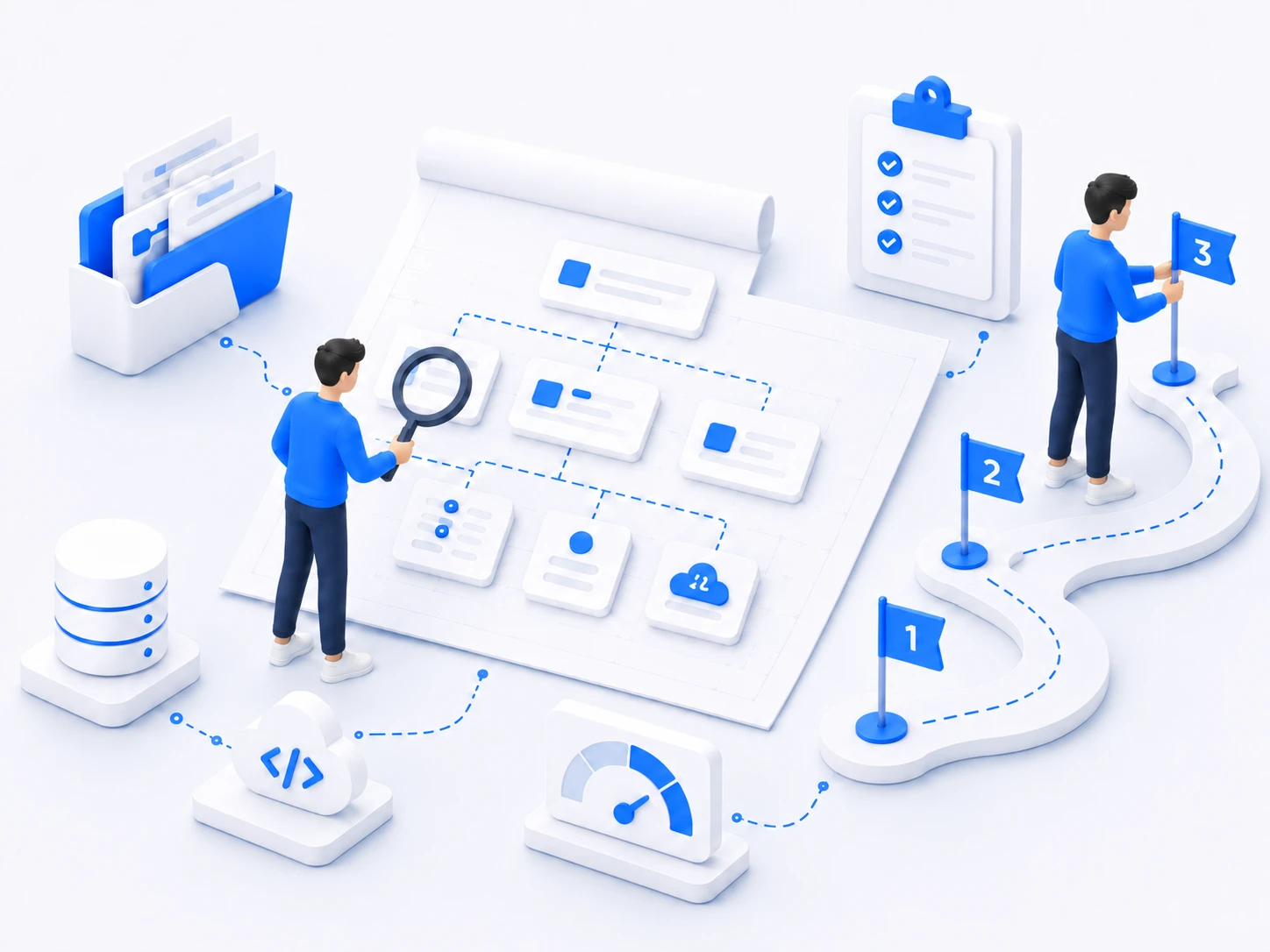
The audit closes the gap between an idea or a problem and a clear plan of work. Four typical situations clients come to us with.
There is a task or a product idea, but no requirements, no architecture and no clear starting point. The audit turns the idea into a plan with stages and priorities.
The system works, but it needs to grow: new features, integrations, performance. The audit shows what to improve, what to rewrite and in which order.
Contractors quote very different numbers and there is nothing to compare them against. The audit gives you an independent reference: scope, architecture and the sequence of stages.
Before investing in full-scale development, it helps to understand the scope of the first version, the risks and the approximate budget. The audit answers these questions without starting the project.
The scope of the analysis depends on the task: for a new system the focus is on requirements and processes; for an existing one we also review the code and the data.
Analysed in every audit
What the business expects from the system, who uses it and which scenarios are critical. If requirements do not exist yet, we formalise them.
How work is organised today: where the manual steps, double data entry and bottlenecks are that the system should eliminate.
What the system will exchange data with: CRM, ERP, accounting systems and external APIs. We assess how ready those systems are for the exchange.
Plus, if a system already exists
The state of the code, technical debt, infrastructure and what can be reused.
Where the data lives, what shape it is in and what will need to be migrated or cleaned before launch.
The audit follows an agreed plan: you know in advance what will be needed from you and when. On your request we work under an NDA.
We discuss the task, goals and constraints, and interview the key people: the task owner, the users and, where available, the technical team.
We study the requirements, processes and documentation and, where needed, the code, data and integrations. Access is requested selectively and only where necessary.
We shape the architecture recommendations, the scope of the first version, feature priorities and the breakdown into stages. Competing options are compared with reasoning.
We compile the results into a plan document, present it, answer questions and adjust it based on your feedback where needed.
The outcome of the audit is a plan document you can use to make a decision about development. The scope depends on the task and is fixed at the start.
Requirements, processes and systems in one picture instead of scattered notes and threads.
How to build the system and on what, with reasoning: why this way and not another.
Where to start, what goes into the first version and in what order to move on.
A range of timelines and budget by stage, and what can affect them.
The audit is deliberately compact: analysis and a plan. Development, design mockups, detailed specifications, testing and rollout run as separate work after it. The scope of the audit is fixed in writing at the start.
Your developers get the architecture, priorities and stage plan and start without a long design phase. We can help you assemble and train the team, and consult along the way.
We continue with the prepared plan: the team is already immersed in the task, stages and priorities are agreed. More about the service on the custom development page.
On process, engineering maturity, and timelines - from the people who saw it from the inside.
«A high level of engineering maturity: not box-ticking, but a detailed analysis of the tasks and the solutions that work best for the startup's goals. I strongly recommend them for technology projects.»
«I spent a long time looking for developers to build an MVP of a mobile app. Axium called me back right away and listened carefully to my request: I liked the businesslike approach, the clear plan and the ideas on how to make the product better. The whole process was as transparent as it gets, and within the agreed timeline we got a result we are happy with.»
«Everything now lives in one portal: our whole team and our clients work in a single system, with no third-party tools.» Video testimonial
«There was no ready-made solution on the market: Axium built one for us in about a month, and it has been running reliably ever since.» Video testimonial
«Axium quickly built an app for our community and got it onto the App Store despite every obstacle. Every fix was handled promptly.» Video testimonial
«I haven't seen a system this strong with any other seller.» the company's CFO
«Any change on the partner side is handled quickly - our integration runs without disruption.»
«Everyone who uses it likes it. We ended up with a great product.»
Describe the task in your request: what kind of system it is, what already exists and what you want to achieve. We will clarify the details, propose an audit scope for your situation and agree on the format.
They are different tools. An estimate answers the question of roughly how much it will cost, and is done quickly from a brief. The audit answers what exactly to build, in what order and why: we analyse your requirements, processes and systems, and shape the result into a plan document. One does not replace the other.
Time from the key people for interviews, the materials you have (requirements, documentation, access to systems where needed) and feedback on the interim results. The exact list is fixed at the start; access is requested selectively, and we sign an NDA on request.
The estimate is given as a range per stage, and we talk through the assumptions it depends on: data readiness, the state of external APIs, the speed of approvals. As the requirements get more detailed, the estimate is refined.
No. The document is formulated independently of the vendor: you can build with your own team or any contractor, and use the plan as the basis of a specification. Continuing with us is also an option, but that is your choice, not a condition.
Yes. For a new system the audit focuses on the requirements, the processes and the scope of the first version: what should go into the first launch to validate the idea with minimal investment, and how to grow the product from there.
That is a normal outcome. The plan stays with you and keeps its value: come back to it when you are ready. Deciding not to build right now is also a useful result of the audit: it saves the budget that would have gone into development without a clear plan.
The duration and cost depend on the scale of the task: a new build with no existing systems is analysed faster than a live setup with code, data and integrations. The scope of work, timeline and cost are fixed in writing at the start, after a short review of the task.
Leave a request: we will clarify the details, propose an audit scope for your situation and agree on the timeline.
Working hours: Mon-Fri 09:00-19:00 · Email: hello@axium.uz