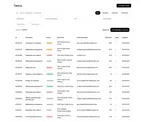


Sales rep app
Photo catalogue, inventory, prices and customer-specific discounts, with order taking at the outlet. Works without internet and synchronises when a connection becomes available.
Mobile apps
Service overviewCRM, ERP and internal systems
Service overviewAI and automation
Service overviewIntegrations and API
Service overviewSupport and development
Service overviewRelated cases
All casesSupport cases are on the way. In the meantime, see the projects we maintain after launch.
See all projects
We develop offline apps for sales reps and dealer portals that send orders to your ERP without calls, manual entry, or paperwork. Your accounting system remains the source of record: we extend it for the field team rather than replace it.
 First version in 4-8 weeks
 Sales rep app
Catalogue, inventory, prices and order taking that works offline.
Dealer portal
A wholesale customer sees their contract prices and places orders directly.
ERP exchange
Inventory and prices come from your accounting system, orders and payments go back.
Analytics
Sales by rep, outlet and SKU, plus receivables and plan attainment.
 Everyday Goods
  OQQI
OQQI  Proseller
 It is a combination of three parts: a sales rep app, a dealer web portal, and data exchange with your accounting system. Product data, inventory, and prices come from the ERP, while orders and payments go back. For a director, this means that the order path no longer depends on phone calls, an operator's memory, or Excel files.
We see these situations in almost every wholesale company we speak with. If you recognise your process, the losses already exist. The only question is their size.
A sales rep dictates an order by phone, and an operator enters it into the accounting system manually. Every retelling creates errors in products and quantities.
The company learns about a lost order from the customer a week later, together with a complaint and a switch to another supplier.
Orders live in Telegram, Excel, and on paper. No one has a single view of the process, including the director.
Sales reps in the field do not see current inventory and prices, so they promise customers items that are not in stock.
Receivables are checked manually. A sales rep ships to a customer who has long been overdue.
Management cannot see the figures by rep and outlet: who is selling and who is simply travelling around.
The scope is selected for your process. A solution is usually assembled from these blocks:
Photo catalogue, inventory, prices and customer-specific discounts, with order taking at the outlet. Works without internet and synchronises when a connection becomes available.
A wholesale customer opens a link, sees the prices in their agreement, places an order, and tracks its status. No call to the manager is needed.
Product data, inventory, prices, and receivables come from your accounting system. Orders, payments, and returns go back. The operator does not re-enter anything manually.
Daily visit plans, visit check-ins, and shelf photo reports. You can see where a sales rep has been and where they have not.
The customer balance is available to the sales rep. If a credit limit is exceeded, an order is blocked or requires approval.
Sales by rep, outlet, and SKU, plus returns and plan attainment. Manage the catalogue, prices, and roles in one place.
Every order is recorded in the system and reaches accounting automatically. There are no more phone retellings.
Hours spent transferring orders to the accounting system disappear. People work with customers instead of typing.
Current inventory and prices are at hand. An order is placed at the shelf in minutes, and promises to customers match warehouse stock.
Orders, returns, and receivables are visible for each rep, outlet, and SKU. Decisions are made on data.
How we start
Before discussing the solution scope, we briefly review the current process: where orders are placed, which accounting system you use, what already works, and where manual work appears.
We have a call and trace an order from a sales rep or dealer to the warehouse. We identify where it is delayed, duplicated, or lost.
The number of reps and customers, current ERP, inventory and pricing rules, field connectivity, and the tools your team already uses.
We show what makes sense to automate first: the sales rep app, dealer portal, integration, or an improvement to an existing solution.
What we define after the conversation
Which process to automate first: the sales team, dealers, ERP exchange, or analytics.
What can be used out of the box, what requires integration, and which data is needed for launch.
A pilot, an improvement to the current solution, or another option, with an honest assessment of how well it fits.
Distribution software does not begin with the same set of screens for every business. For some, the bottleneck is the sales team; for others, it is dealers or ERP integration. The review prevents unnecessary work and helps select the first step that will make a difference in your process.
20-30 minutes to understand your process and the next step.
Discuss your needsWe work with mid-sized distributors where order intake has already become a bottleneck: demand exists, but the process depends on people and phones. Enterprise platforms are built for networks of hundreds of reps, so mid-sized businesses often overpay for excess capacity. We build for your scale.
Food, beverages, and household chemicals with a high volume of small orders from retail outlets.
Wholesale with complex price lists, discounts, and receivables by customer.
A broad catalogue where an error in one item creates a return.
Equipment, furniture, and construction: dealers order directly through the portal.
Signs that automation makes sense
We do not start with oversized projects. The right approach is to calculate first and build in stages.
The cost depends on the scope. A sales rep app launches faster and costs less than a full portal and deep integration. For a useful estimate, we first review the current process, ERP landscape, and the required first stage.
On process, engineering maturity, and timelines - from the people who saw it from the inside.
«A high level of engineering maturity: not box-ticking, but a detailed analysis of the tasks and the solutions that work best for the startup's goals. I strongly recommend them for technology projects.»
«I spent a long time looking for developers to build an MVP of a mobile app. Axium called me back right away and listened carefully to my request: I liked the businesslike approach, the clear plan and the ideas on how to make the product better. The whole process was as transparent as it gets, and within the agreed timeline we got a result we are happy with.»
«Everything now lives in one portal: our whole team and our clients work in a single system, with no third-party tools.» Video testimonial
«There was no ready-made solution on the market: Axium built one for us in about a month, and it has been running reliably ever since.» Video testimonial
«Axium quickly built an app for our community and got it onto the App Store despite every obstacle. Every fix was handled promptly.» Video testimonial
«I haven't seen a system this strong with any other seller.» the company's CFO
«Any change on the partner side is handled quickly - our integration runs without disruption.»
«Everyone who uses it likes it. We ended up with a great product.»
Yes. The catalogue, inventory from the latest sync, prices, and order placement are available offline. Once connectivity appears, orders are sent to the accounting system and reference data updates. This is a key requirement for field teams in the regions, so we design offline mode from the start.
We start with your existing accounting system. For 1C, including Trade Management, Small Business Management, ERP, and industry configurations, we identify the available exchange method. For another ERP, we first review its API and architecture. We state clearly what can be integrated as standard and where custom work is needed. The exchange is designed in both directions: reference data and inventory come from accounting, while orders and payments go back.
No. Your accounting system remains the source of record, and we add a field layer with an app and portal. If you already have a working solution, we first assess whether it needs to be replaced at all. We seriously consider the option of leaving things as they are.
The first working version takes 4-8 weeks after the scope is agreed. We usually begin with a pilot for part of the sales team, collect feedback, and then roll it out to everyone.
Yes. This is a common approach for manufacturers with dealer networks. The portal opens by link, needs no installation, and launches faster. The sales rep app can be added in the second stage once the portal proves its value.
Access is role-based: sales reps see only their customers and prices. Data is stored on your server or in a dedicated cloud, and ERP exchange uses a secure channel. The details are documented in the contract and NDA.
A distribution solution is assembled from our core services.
Tell us how you receive orders today: how many sales reps or dealers you have, which accounting system you use, and where manual work appears. We will follow up with questions during the business day.
Working hours: Mon-Fri 09:00-19:00 · Email: hello@axium.uz