



Skip to content
Axium
en
Estimate the costTakes about 2 minutes to fill in

Integration cost

System integration cost: what drives the price

We break down what work you are paying for, what you get after the estimate and why a quote cannot be built from system names alone.

  • An estimate based on your systems, data and scenarios
  • The scope of work is fixed in writing before we start
  • External costs appear as separate line items in the quote
IT Park Resident
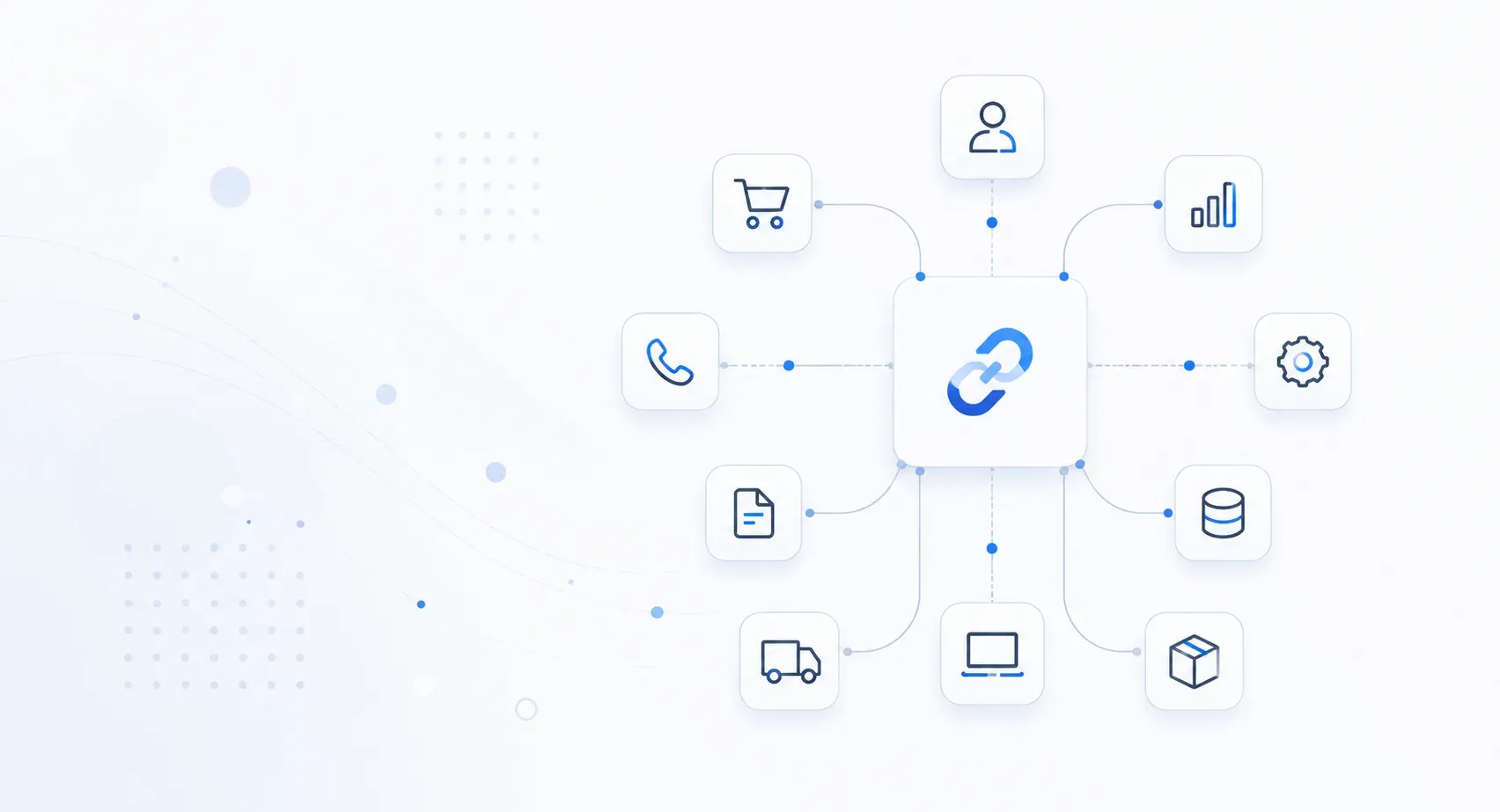
CRM, ERP and API integration diagram: data exchange between systems

What makes up the cost of an integration

There are no off-the-shelf plans for integration: even typical connections differ in the details. Every company has its own system configurations, data quality and exchange rules. The price depends on the number and complexity of the systems, API readiness, the volume and quality of data, exchange scenarios and security requirements. So we analyse the task first, then present a quote with the work itemised by stage.

What affects the cost of an integration

Six factors define the final quote. We use them to estimate the project and break the cost down by stage.

01

Number and complexity of systems

The more systems and the less standard their logic, the larger the data exchange effort.

02

Volume and structure of data

Complex formats and large volumes require extra processing and field mapping.

03

Business processes and scenarios

Unique exchange rules and conditions are reviewed and configured separately.

04

Custom development

Non-standard tasks and adapters for closed systems increase the effort involved.

05

Security and SLA

Requirements for data protection, fault tolerance and response time shape the architecture.

06

Support level

Monitoring and maintenance after launch are matched to how critical the integration is.

Why an exact price cannot be quoted from system names

Two integrations of the same products can differ in effort by several times. These things only surface once the task is analysed.

01

API quality varies

One system has a well-documented API, in another the methods do not behave as described. The adapter work depends on this.

02

Data may need cleaning

Duplicate counterparties and mismatched reference data have to be resolved before the exchange goes live, or the systems will overwrite each other's records.

03

Exchange direction differs

A one-way export and a two-way sync with conflict resolution are very different tasks in terms of effort.

04

Closed software may be involved

If an accounting system has no open API, the exchange is built through files, the database or vendor-side changes. The approach is determined during analysis.

05

Security requirements differ

Encryption, access control and operation logging add work, and their scope is specific to each project.

06

Exchange volume and business rules

The price depends on how much data moves between the systems and under which rules, not on the product names.

What you get after the estimate

The result of the estimate is a document you can base a decision on, not a single number without a breakdown.

01

Data exchange diagram

The list of systems to connect, the data flows between them and the direction of exchange for each flow.

02

Project boundaries

What is in scope and what stays outside it. Grey areas are named upfront rather than discovered along the way.

03

Required access

The list of accounts, permissions and approvals needed from your team and from the system vendors.

04

Risks and constraints

What can shift the timeline or change the scope: closed APIs, data quality, dependencies on third parties.

05

Stages and preliminary timeline

The sequence of work with an approximate duration for each stage.

06

Acceptance criteria and stage pricing

Which checks each stage is accepted against and what it costs. Payment is tied to the result of the stage.

What the price covers and what is billed separately

The quote separates Axium's work from external costs. Below is a typical split: the exact composition differs per project and is fixed in the quote before the start.

Usually included in the price of the work

  • System analysis and exchange design
  • Description of data flows and exchange directions
  • Adapter development, API and webhook setup
  • Mapping of reference data and fields
  • Error handling and retries on failures
  • Testing and data reconciliation between systems

Usually billed separately

  • Licences for external systems and paid APIs
  • Servers and cloud infrastructure
  • Vendor-side changes to a closed system
  • Cleaning and migration of historical data
  • Additional modules beyond the agreed scope
  • Round-the-clock monitoring and extended support
  • New requirements that appear after the scope is agreed

Which of these your project needs becomes clear after the assessment: such items appear as separate lines in the quote before work begins.

Integration stages

Each stage affects the final cost and timeline. We define the tasks and agree on the scope of work in advance.

  1. 1 Analysis and audit

    We study your systems, goals and data volume. We identify integration points and risks.

  2. 2 Design

    We design the exchange architecture and agree on the scenarios and APIs.

  3. 3 Configuration and development

    We implement the integration, set up the exchange and build the custom tasks.

  4. 4 Testing

    We verify that data is transferred correctly and that the system stays stable.

  5. 5 Launch and support

    We ensure a smooth transition, train your team and provide support and monitoring.

How the scope of work is fixed

Before the start we put in writing which systems we connect and which data and scenarios the exchange covers. For each entity we define the source of truth: which system takes priority when records diverge. Error handling rules and the acceptance criteria for the result are described separately.

  • Systems, data and exchange scenarios are listed in the statement of work
  • A source of truth is defined for each entity
  • Error handling rules and acceptance criteria are agreed in advance
  • New requirements are estimated separately and are not implemented without sign-off

Why it pays to work with us

A clear quote, an engineering approach and support after launch.

Transparent process

Pain
It is unclear what the quote consists of and what it covers.
Solution
We break the cost down by stage and fix the scope of work before we start.
Outcome
You see which work you are paying for.

Engineering approach

Pain
The integration breaks at the first change in one of the systems.
Solution
We design the exchange with error handling, logging and data reconciliation.
Outcome
Failures are visible immediately, not a week later through customer complaints.

Support after launch

Pain
The contractor disappears after deployment and no one answers questions.
Solution
We maintain the integration, answer questions and investigate incidents.
Outcome
You are not left alone with the data exchange.

What people who've worked with us are saying

On process, engineering maturity, and timelines - from the people who saw it from the inside.

Analytical mindset
engages with the business need rather than mechanically executing the spec
Proactivity
goes beyond the minimum scope of the agreement
Outcome-driven
proposes alternative technical paths aligned with business goals
  • «A strong level of engineering maturity: not just formal delivery, but a thorough analysis of the brief and decisions optimised for the company's goals. I confidently recommend the team for technology projects.»

    Co-founder and CTO of the client company

  • «Everything now lives in one portal: our whole team and our clients work in a single system, with no third-party tools.» Video testimonial

    Ahmadjon Tohirjonov

    Founder and CEO

  • «There was no ready-made solution on the market: Axium built one for us in about a month, and it has been running reliably ever since.» Video testimonial

    Роман Головатенко

    Head of Coffee Box

  • «Axium quickly built an app for our community and got it onto the App Store despite every obstacle. Every fix was handled promptly.» Video testimonial

    Умар

    Owner of the Uncle Chill barbershop

  • «I haven't seen a system this strong with any other seller.» the company's CFO
    «Any change on the partner side is handled quickly - our integration runs without disruption.»

    Олег Репин

    Head of Analytics

  • «Clear plan, transparent process, delivered on time. I confidently recommend them as a strong team.»

    Азамат Маткаримов

    Founder and CEO, Make My Day

  • «Everyone who uses it likes it. We ended up with a great product.»

    Client of a logistics platform

Discuss your project response within 24 hours

The cost depends on the systems and scenarios

We give a precise quote after analysing the task: which systems we are connecting, which data and exchange scenarios are needed and what state the APIs are in. We provide a preliminary estimate within 1-2 business days of the brief.

Pricing FAQ

What is included in the integration cost?

System analysis, exchange design, description of data flows, adapter development, API and webhook setup, mapping of reference data, error handling, testing, data reconciliation, documentation and launch. External costs appear as separate line items in the quote.

What is billed separately?

Licences for external systems and paid APIs, servers and cloud, vendor-side changes to a closed system, data cleaning and migration, round-the-clock monitoring and extended support. Requirements that appear after the scope is agreed are estimated separately.

How quickly can I get a quote?

We usually provide a preliminary estimate within 1-2 business days of the brief. A precise quote requires a detailed discussion of the tasks and, if needed, access to the API documentation.

What determines the integration timeline?

The timeline depends on the number of systems, the complexity of the scenarios and how ready the APIs are. Standard tasks start from 7 days; projects involving closed systems or data cleaning take longer.

Get a consultation and a quote

Leave a request and an expert will get in touch, clarify the details and prepare a tailored proposal.

Working hours: Mon-Fri 09:00-19:00 · Email: hello@axium.uz

What happens after your request

  1. Intro call: We clarify business goals and context. If needed, we sign an NDA immediately.
  2. Requirements analysis: We review your operational flow, identify technical risks, and map integration points (1C, CRM, ERP).
  3. Plan and estimate: We prepare a transparent proposal (SOW) with stages, timeline, and a fixed budget framework.
Confidentiality guaranteed An engineer replies
Project type

This request takes about 1 minute