
Process automation
Fewer manual operations, fewer errors, and faster work.
System integration
We connect 1C, CRM, ERP, websites, and mobile apps into a single environment. We automate routine work, sync data, and cut manual errors.
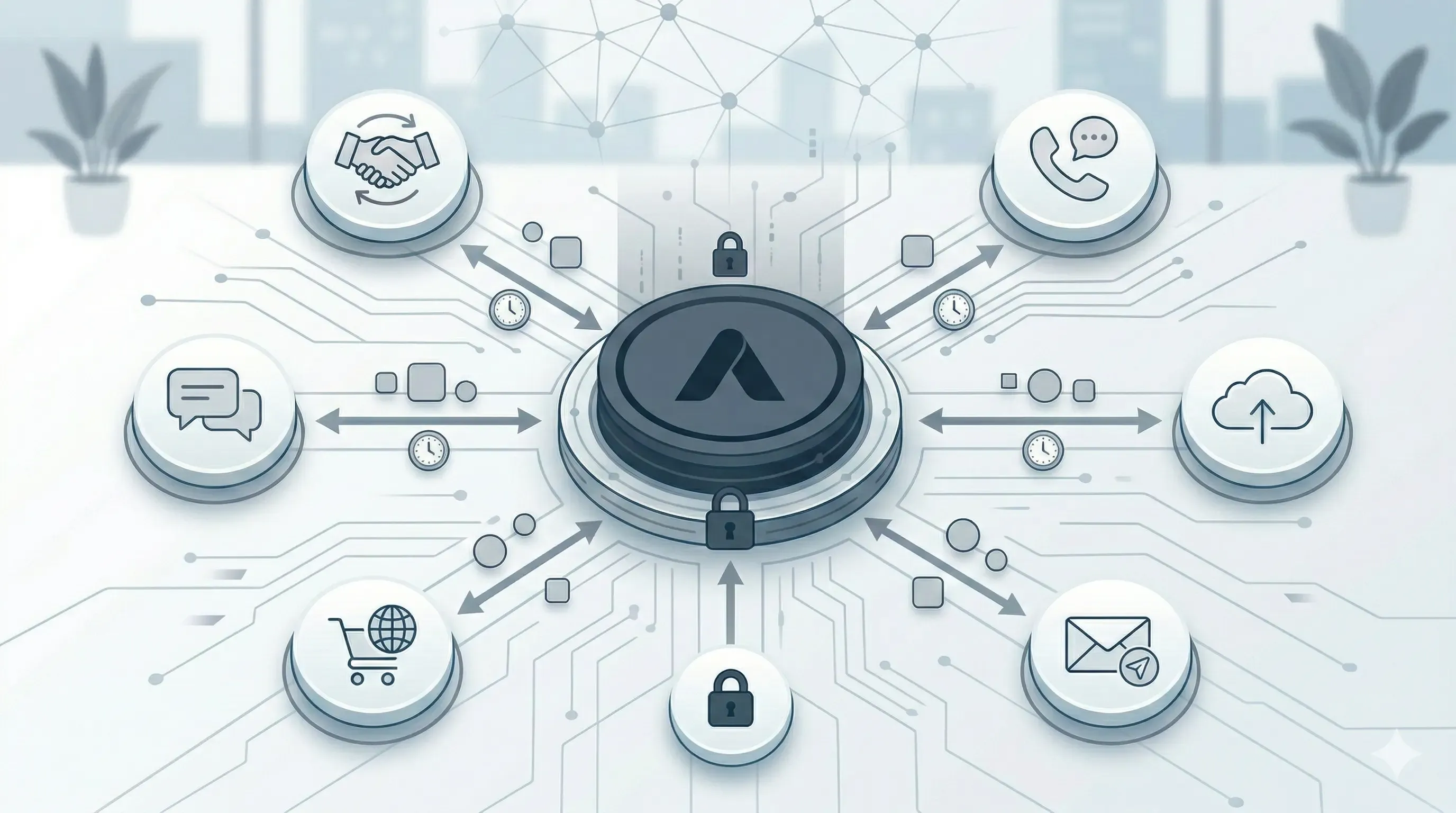
System integration means connecting different programs and services into a single environment where data is transferred automatically. Instead of manually moving information between 1C, CRM, ERP, your website, and your app, the systems exchange data directly: via APIs, webhooks, or ETL. As a result, your catalog, stock, orders, and customers stay consistent, processes speed up, and the number of errors drops. Below we break down the key integration capabilities and what your business gains once it goes live.
The feature set is tailored to your business needs: from data exchange to automatic notifications and analytics.
Fewer manual operations, fewer errors, and faster work.
Synchronization across 1C, CRM, ERP, websites, and mobile apps.
Connect external and internal services via REST, SOAP, and Webhooks.
Push, email, SMS: instant updates for customers and staff.
Automatic collection and visualization of key metrics for decision-making.
Encryption, access permissions, and event auditing to protect your data.
Not just integration, but measurable impact: less manual work, consistent data, and transparent analytics.
Data moves between systems automatically, with no double entry.
Catalog, stock, orders, and customers stay consistent across every system.
We eliminate the discrepancies that come from moving data by hand.
Requests, orders, and statuses update in real time.
Metrics are collected automatically and ready for decision-making.
New services and systems connect as your business grows.
Data from one system is passed to another via APIs or webhooks, runs through processing, and lands in the right service. Once the operation completes, a notification is sent.
Data path
We support REST, SOAP, webhooks, and ETL. We choose the connection method based on API availability and data volume.
Integration pays off at any scale: from automating routine work in a small team to a single corporate environment.
Automating routine tasks and exchanging data between systems.
Integrating corporate ERP, CRM, and BI systems into a single environment.
Configuring APIs and webhooks and supporting digital processes.
Launching an MVP quickly and connecting services as you scale.
A transparent process from requirements analysis to launch and support. We work with companies in Uzbekistan, Kazakhstan, and other countries.
Step 01
We analyze your business processes and define integration goals and data exchange points.
Step 02
We determine which platforms and services will be connected and agree on the architecture.
Step 03
We implement the integration via APIs, webhooks, ETL, or a direct connection.
Step 04
We verify correctness, security, and performance, then put it into production.
Step 05
We provide monitoring, updates, and scaling of the solution.
On process, engineering maturity, and timelines - from the people who saw it from the inside.
«A strong level of engineering maturity: not just formal delivery, but a thorough analysis of the brief and decisions optimised for the company's goals. I confidently recommend the team for technology projects.»
«I haven't seen a system this strong with any other seller.» the company's CFO
«Any change on the partner side is handled quickly - our integration runs without disruption.»
«Clear plan, transparent process, delivered on time. I confidently recommend them as a strong team.»
«Everything now lives in one portal: our whole team and our clients work in a single system, with no third-party tools.» Video testimonial
«Everyone who uses it likes it. We ended up with a great product.»
The final cost depends on the number of systems, the data exchange method, the data volume, and security requirements. We provide an estimate after reviewing your requirements.
We apply encryption, access control, and event auditing. Every integration is tested for vulnerabilities. Learn more: about integration security.
The timeline depends on the number of systems and the complexity of the scenarios. A basic integration usually takes from a few days to a couple of weeks. We give exact timelines after analyzing your requirements.
We work with 1C, Bitrix24, amoCRM, SAP, ERP, websites, apps, and any service with an API. List of supported systems.
Describe the systems you need to connect and your current processes. We will propose a data exchange architecture and estimate the integration.
Working hours: Mon-Fri 09:00-19:00 · Email: hello@axium.uz